Writing
Burning outNote
I Go Down Rabbit HolesNote
RSS Readers I RecommendNote
Late night BBQ and whiskeyLink
Refreshingly SimpleLink
Some British slangs: - A bricky is a bricklayer - A…Note
Working in Folyes Cafe. The laptop in the image was…Note
The Story Behind Naripod: A Quest for AuthenticityEssay
Why Is It So Hard To Create Good Art?Essay
Humans Play With FireEssay
Human Perception Is Also Prompt BasedEssay
Martin Eden (2019)Essay
Some Kind of Peace: Olafur ArnoldsEssay
Why I'm Leaving the Film Visual Effects Industry After 13 YearsEssay
- Note
Burning out
Guess what, I am feeling extremely burnt out.
Although I try to brush it off, the feeling of burning out is such a commonplace for founders.
I do wonder where it comes from.
But right now I feel:
- extremely unmotivated
- tired, sleepy, numb
- unable to focus on any meaningful tasks
- anxious about everything else
The worst thing about being a founder I think is you are alone, in this boat, in the vast ocean of possibilities and challenges. No one outside this world can really relate to you.
For most people, once they finish the day’s work, they can completely shut off. Not founders, there’s always something else you can do, and always something else needs attending to.
I also feel very restless, so I started changing this blog and finishing up the comment system.
Because tokens never sleep right?
I Go Down Rabbit Holes
One of the things my friend Amel said still cracks me up in the middle of the night, or any other random occasions it decides to enter my mind:
“I go down rabbit holes.”
Well, that just sums it up for all of us.
We are professional rabbit holes digger, one after another.
Sometimes we don’t even know why we go down each hole. The hole itself has become the point.
Do you find yourself going down rabbit holes?
There must be a name for this problem.
RSS Readers I Recommend
So far I have tried 2 apps for managing and reading RSS feeds, I can recommend either of them without any issues.
Neither is perfect, but it is more about philosophy than being technically weak.
This is very old and based on what I know it’s the OG RSS reader, very practical, 3 column design. I use it on Mac and iPhone, works great.
This is a new one I found a few days ago. Overall it has a different design, instead of treating feeds as emails or messages, it treats them as streams.
And feeds naturally fade over time at different rates.
Interesting concept, and it actually tries to redesign the decade old 3 column design.
~I actually alternate between these 2 right now. Hard to say which one I prefer.
Late night BBQ and whiskey
youtube.com ↗ (opens external site)Been watching this man’s late night dinner for a while, usually playing in the background when I work.
It’s super relaxing to watch. It’s quiet, deliberate and precise, and most importantly it always looks tasty.
I would love to have this tiny man cave, with all the whiskeys and BBQ.
There is something really interesting about the Japanese culture, it’s hard to put into words but to me it comes down to a sense of deep respect to everything you touch and your surroundings.
Do you agree?
To that, I have a lot to say actually, will write it down another time.
Refreshingly Simple
bearblog.dev ↗ (opens external site)Although this blog isn’t really built or run on
bearblog.dev, I do really like that product.It’s so refreshingly simple, in this day and age.
Every day we are bombarded with endless meaningless, polished, sloppy new products. Having something like Bear Blog really makes me miss the good old internet of 90s.
There is also this neat discovery page: Discover
Maybe I’m just getting old. But I do feel this feeling is being shared in many of us.
- Note
Note from 2026-09-01
Some British slangs:
- A bricky is a bricklayer
- A sparky is an electrician
- A chippy is a carpenter
- Note
Note from 2026-09-01
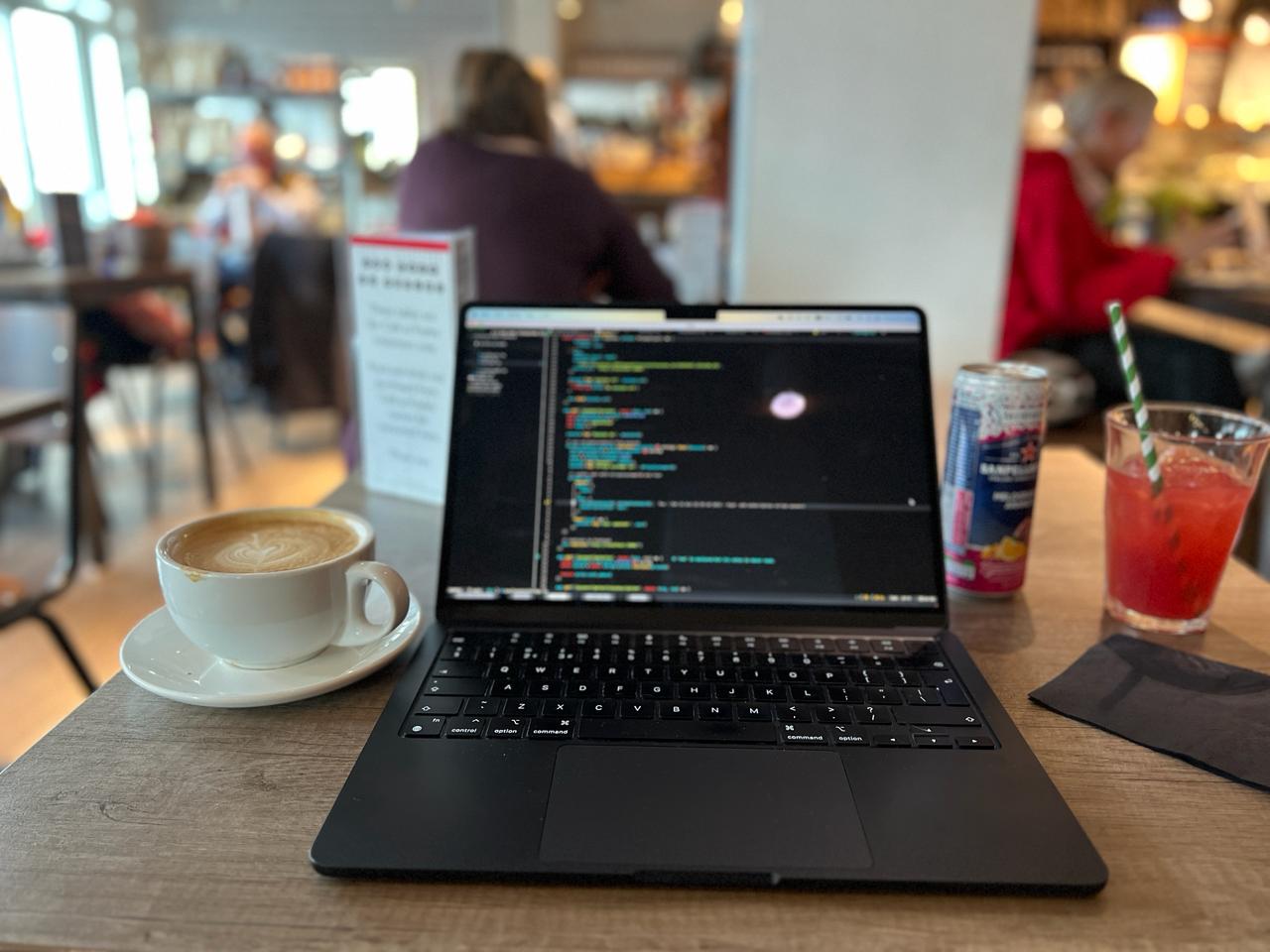
Working in Folyes Cafe. The laptop in the image was struggling a lot.
The Story Behind Naripod: A Quest for Authenticity
Podcasts are polished. Social media is curated. But real life? It’s messy, emotional, and full of incredible stories waiting to be heard. I created Naripod for those stories.
I Listen Everywhere
I listen to stories everywhere. When I work, when I walk, when I travel on public transport, when I wait for a friend, when I cook, and even when I try to fall asleep. Stories are woven into the fabric of my daily life.
But finding these stories? That’s the hard part. I’ve tried podcasts, which are great in their own right, but they’re not always about stories. They’re for everything. And when they are, they’re often highly polished shows, containing much more than just the raw narrative I crave.
Discovering more interesting stories based on what I actually like is a challenge. The current system makes it difficult.
What I truly love are real people telling their own stories, or stories that happened around them, told in their own voices. It’s that raw, authentic feeling I’m always searching for. I find glimpses of it on TikTok, Instagram, sometimes in podcasts, or YouTube videos. But there’s no dedicated space for this kind of storytelling to truly exist.
I feel like I’m bending other platforms to my need to listen to stories. Those platforms are simply not made for that, and it’s hard to find stories, not to mention a non-stop listening experience hands-free on the go.
Building It
This persistent need led me to the idea of building my own platform. It started as a personal quest, a space I desperately wanted for myself. But I quickly realized that many of my friends shared this same desire – a love for real stories, which are surprisingly hard to come by.
One Story
There’s a user who is now telling the stories of his grandparents. These are people he doesn’t even know, but the stories were relayed by his mother. They span decades, covering periods like the Cultural Revolution and World War II. It was a heavy and shocking narrative.
Unbeknownst to him, the actions his grandparents took strongly influenced his parents’ lives, which in turn, deeply affected his own life in ways he didn’t realize. This exploration into his grandparents’ lives accidentally revealed the origin of his own psychological pain, giving him a new angle to address it.
From Film
I come from the film industry, with over 15 years of experience. I’ve always been drawn to stories. While Hollywood has become quite homogenized, my love for authentic narratives needed a new outlet. I started watching more documentaries and indie films, where more intimate, less polished stories could shine.
But making a film, even a documentary, is incredibly difficult. The economics of the film industry mean you can’t just create a film about any story. Yet, there are so many stories worth telling in the world.
Think about the people you meet every day – a cab driver, a barber. They often have incredible personal stories, small but hard to believe, that happened in plain sight. These stories are worth telling, but without a dedicated space, they get forgotten, left out, and eventually lost.
How It Works
Naripod’s whole design is to allow people to record and publish stories with as little friction as possible. The philosophy is that the whole platform is built for storytellers and story listeners.
I envision an app where you can open it, pick a starting story or a few, and then just go about your day. Jogging, exercising, cooking, commuting, driving – the stories will play continuously. After one finishes, relevant stories or ones you might be interested in based on your listening preferences will automatically start.
It’s about a hands-free, immersive experience, much like music apps. You don’t need to constantly interact with your phone. If you don’t like a story, you can simply skip it after a few seconds. The goal is to be completely immersed in real stories, to feel the textures of other people’s lives, the raw emotions coming from them.
Why It Matters
Connecting with someone I don’t know through their experiences energizes me. Humans have this natural tendency to listen to other people’s stories, for whatever reason. It’s an innate drive to connect and understand each other through shared experiences, even those we haven’t lived ourselves. Naripod is built on this fundamental human connection.
Why Is It So Hard To Create Good Art?
Why is it so hard to create art? It’s a question I’ve found myself mulling over countless times, usually when staring at a blank page or marvelling at someone else’s masterpiece. Why is it inherently hard to create anything good in art?
Here’s what I think:
Humans love organisation. We’re wired to seek structure and coherence in everything around us, from our surroundings to the stories we tell. But this preference makes creating art uniquely challenging. Often, the most easily accessible ideas or content feel unpolished or chaotic, and refining them into something meaningful takes extraordinary effort.
Think about it: natural, unstructured patterns might be fascinating in their own way, but we instinctively crave order. Content that feels too raw or unorganised is often dismissed as less valuable. This creates a distinct tension in the creative process. How do you shape something chaotic into something organised, without losing its essence?
The more organised the art, the harder it is to create. And yet, paradoxically, the more effort you pour into it, the more it’s appreciated. It’s as if audiences can sense the labour, the meticulous crafting, and they reward it with their admiration.
Take Arcane, for example. Watching that show was a revelation for me. Every frame is a work of art—a perfect balance between realism and stylised interpretation. The characters and environments aren’t just visually stunning; they’re also a testament to how much thought and care goes into creating something that feels both organised and alive.
Art isn’t like photography or recording, where reality is captured exactly as it is. Art demands a process of reduction and categorisation, a deliberate decision to emphasise some details while letting others fade into the background. Sometimes these choices happen instinctively, in the flow of creation. Other times, they’re painstakingly deliberate, aimed at achieving a specific style or emotion. Either way, it’s this process of organising chaos that makes art so compelling.
In Arcane, the animators didn’t just replicate the world; they elevated it. Hyper-detailed textures merge with exaggerated forms, creating something that feels more real than reality. It’s a version of the world that’s been carefully filtered and reimagined, designed to make your brain light up with wonder and comfort. That’s the magic of great art—it resonates because it’s organised just enough to feel intentional, but not so much that it loses its soul.
So why is it so hard to create art?
Creating good art is hard because it’s more than just making something look nice. It’s about taking messy ideas and inspiration and shaping them into something that truly connects. When it all comes together, it feels magical—a reminder that even in life’s noise, we can create beauty and meaning.
Humans Play With Fire
Understanding something before fully utilizing a technology is the norm for humans. When we discovered how to create and use fire, we didn’t really contemplate what it was or how it functioned.
Through trial and error, we uncovered remarkable applications for fire, and as a result, we humans, as a species, gained an overwhelming advantage over all others, allowing us to dominate the entire food chain.
Fast-forward to today, we have somehow managed to build quantum computers and perform calculations with them, yet we do not fully grasp how they operate. We simply know from trial and error that they accomplish what we intend, aiding us in achieving our objectives.
The same narrative applies to AI development. We have established a relatively straightforward set of processes and rules for training, solidifying, and running AI systems. It somewhat mimics the workings of our brains, where neurones are interconnected and transmit signals to and from each other.
However, at a fundamental level, we do not truly understand how it functions; with enough individual components operating and communicating together, emergent behaviours arise.
Humans, once again, eagerly engage with tools we don’t completely comprehend.
Recently, I began exploring topics related to UFOs/UAPs, prompted by a series of events. First was the New York Times article released about UAPs, followed by the congressional public hearing on UAP disclosure, and then the book written by Luis Elizondo, “Imminent.”
One of the most astonishing aspects of this topic is a person named Bob Lazar, who allegedly claimed since the 90s that he had worked at the infamous Area 51, S4 test base, where he was tasked with reverse engineering the anti-gravity engine that powers the UAPs they have captured.
I don’t want to delve into whether I believe Bob’s claim is true, but what intrigues me is the idea that if we were to figure out how to replicate this anti-gravity engine, we would fully exploit the advantages this technology offers, without a clear understanding of what it entails, how it operates, or what hidden costs might be involved.
That’s just us, a group of egalitarian primates excitedly seizing any opportunity to equip ourselves with more advanced tools.
Human Perception Is Also Prompt Based
There Is Something There
We’ve all had the experience: you just watched a horror film.
Now everything you see doesn’t seem very natural anymore. At the corner of your eyes, you start seeing something that’s not there. As if there’s something out there, only starting to show up right after you’ve watched the horror film. We naturally see patterns in chaos—that’s not news—but we can all agree the peak of these hallucinations happens right after we are exposed to a certain scenario.
Even less noticeable are scenarios of the natural kind, in terms of stories, such as romcoms, adventure, or action films. They prime us to perceive the world with a bias toward the information presented in the story.
This led me to believe that our own perception is also prompt-based.
Diffusion Models
The diffusion model (first described in detail in “Denoising Diffusion Probabilistic Models”), if you don’t know what it means, is essentially a process for AI to come up with useful results out of nothing but random noise.
The process roughly goes like this, in the case of image generation:
- Start with the machine generating a full canvas of noise.
- You tell the AI what you want the final result to be in words: the prompt.
- It starts experimenting with activating neurones in the AI model, which in turn creates slightly different noisy patterns that, in one way or another, get closer and closer to what you described in the prompt.
- After the AI reaches a point of maximum iteration number, or when it thinks the difference between the result and your prompt is small enough, it stops and gives you the final result.
Human Perception As A Diffusion Model
Our perception is awfully flawed. Our vision system, for instance, which we might think is super perceptive, is still very limited. Only the core of our vision is able to discern information in high definition, while the rest of the field of vision is just blurry and sparse pixels.
We don’t feel that way, do we? If you force yourself to “see” things with peripheral vision, you start to realise you can’t actually see much.
But why do we feel like we have a full vision, including the parts where we can’t actually perceive? The reason is our brain is constantly filling in the lost information. Even when we’re most sober, there is still bias, distortion, or inclination based on who we are and where we are at, in any given moment.
This brings up my point: our perception system is actually prompt-based as well, similar to the diffusion model. We are seeing what we want to see or what our brain thinks we are most likely seeing.
This is why, given the same amount of information (or lack of it), we feel differently when our mentality shifts. When we feel happy, we perceive the surroundings to be more positive; when we feel anxious, triggers and alarms spring up from all over the place. Psychological factors aside, I suspect there might be subtle alterations in reality, or at least our interpretation of reality, based on our internal prompts.
Back to the example at the beginning: right after we are exposed to terrifying stories, we tend to make up non-existent objects from our peripheral vision because the prompt is in our short-term memory and is dominant in the active interpretation process running in the background all the time.
Real World Examples
Although probably no one has put it like this, the principle has been used in practice in many areas of our lives.
Advertising
When you think about influencing people toward a specific goal, nothing is better than studying advertising. From something as subtle as product placement in films and TV to the flashy banner ads you see on websites, all ads, at their core, aim to prime and lead you into the funnel: awareness, consideration, and eventually conversion into a paying customer.
Priming is such an important tool that a large portion of advertising budgets actually goes to this stage, especially for well-known brands in the consumer or commodity sectors.
Take, for instance, the Red Bull racing experiment conducted by researchers at Boston College’s Carroll School of Management: participants were asked to play a racing video game where the only difference between cars was the brand logo displayed. Those who drove cars with the Red Bull logo exhibited notably more aggressive and risky behaviour compared to those driving cars with other brands like Coca-Cola, Guinness, or Tropicana. The intriguing aspect? The cars had identical performance capabilities—the only variable was the logo.
This experiment illustrates how brand priming can subtly influence behaviour at a subconscious level. The participants driving the Red Bull-branded cars were unaware of their altered racing style—some excelled with their aggressive approach, while others crashed due to excessive risk-taking. This behavioural shift was rooted in the Red Bull brand’s carefully crafted identity of extreme sports and edgy marketing, highlighting how deeply brand prompts can shape our actions without our conscious awareness.
In both cases, these stimuli guide you through chaos and noise, helping you focus not on what’s random, but what feels aligned with your primed perception. Your hand reaches for the product, seemingly on its own.
Self-Affirmation
Saying nice things to yourself in front of the mirror every day is a proven technique backed by self-affirmation theory to solve many psychological issues.
- You are the best version of yourself.
- You are beautiful.
- You can achieve X, Y, and Z.
These mantras are essentially short prompts for our minds, preparing us to tune in to the correct frequencies amid everyday challenges. The power of such prompting on behaviour has been demonstrated in various studies, including the famous “Florida effect” experiment. In this study, participants who were exposed to words associated with elderly people (like “Florida,” “old,” and “retired”) unconsciously began walking more slowly afterward—showing how even subtle prompts can shape our actions without our awareness.
When faced with a difficulty, a poorly primed mind might perceive it as overwhelmingly destructive, halting progress and deflating confidence. A well-primed person, however, might interpret the difficulty as something positive—perhaps a chance to test out a theory, an opportunity to find flaws, or a passage of adventure that shakes out competition.
Whether through short-term prompts (motivational quotes, group support) or long-term prompting (education, self-affirmation), properly primed people are more resilient during rough patches and better able to find meaning in the presence of hardship.
We shape ourselves in response to life’s ups and downs, and the prompts affect how we perceive and make decisions. In a way, prompt-engineering ourselves is probably worth exploring further. From interacting with AI systems, we know that the quality of input prompts determines the quality of the output.
Memory As Prompt
Memories are not real—well, they are real in a way, but not in the present. As shown in Elizabeth Loftus’s fascinating work on false memories, what has happened is in the past, and it exists only in its consequences and in our minds. It shapes our current decisions, sometimes for better, sometimes for worse. The past is not reality, and in most cases, our memories don’t even fully represent what actually happened. Our emotions and biases tend to modify events to form a cohesive narrative. And that’s exactly what memories are: narratives that help us organise and make sense of the chaotic world.
Memory itself is a form of prompting. AI models use this concept too. When given a series of memories, the model shapes its responses to align with those memories, creating relevance and continuity.
Of course, memories exist on both a personal and collective level. They provide a large contextual prompt for what we do, allowing us to avoid starting from scratch and instead build on what we already “know.”
Emotion As Prompt
How about emotions? I think they are also acting as prompts, perhaps some of the most powerful ones we experience. Our emotional state serves as a filter through which we perceive and interpret the world around us.
When we’re anxious, this emotional prompt leads us to:
- Interpret neutral facial expressions as threatening
- Notice more potential dangers in our environment
- Focus on negative possibilities in future scenarios
Conversely, when we’re in a positive emotional state:
- We’re more likely to see opportunities rather than obstacles
- Social interactions are interpreted more favorably
- Our threshold for stress and frustration increases
Research in affective neuroscience supports this view. Studies have shown that the amygdala—our emotional processing center—can influence visual processing as early as 80 milliseconds after stimulus onset. This suggests that our emotions aren’t just reactions to our perceptions, but actually shape how we perceive things in the first place.
Consider the phenomenon of “emotional contagion”, where we unconsciously mirror the emotions of those around us. This could be viewed as a form of social prompt that influences not just our own emotional state, but our entire perception of the social environment.
Even physical sensations can be reinterpreted based on our emotional prompts. The same physiological arousal (increased heart rate, sweating) might be interpreted as excitement when we’re happy, but as anxiety when we’re stressed—demonstrating how emotional prompts guide our interpretation of bodily signals.
Why Do I Write This?
It happened exactly like the opening: I watched a horror film, and then I started seeing things. The fact that this happens right after watching the horror film is what makes it so fascinating to me. It’s as if I’ve unlocked a dormant capacity—one I haven’t used in a long time. Because of the recent exposure to unsettling images, my short-term mental prompt has shifted. Now, I’m interpreting the randomness and noise around me based on this newly set prompt.
Most people are familiar with this effect—feeling spooked and hyper-aware after consuming horror media. But I think there’s something deeper hiding beneath this phenomenon. This must be how our brains fundamentally work, or potentially how any neurological systems operate (even artificial ones), regardless of their strength or complexity.
Our perception systems are inherently designed to respond to prompts, even in subtle or seemingly insignificant scenarios. This raises an intriguing possibility: could we consciously harness this mechanism as a tool for achieving our goals?
For instance, if the brain is so ready to process prompts, perhaps we can design ways to prime ourselves to interpret randomness and chaos in more constructive, positive ways. Just as exposure to horror primes us to see shadows as threats, could deliberate exposure to certain stimuli prime us for confidence, creativity, or problem-solving?
The AI Connection
Another question lingers in my mind: did the developers of AI systems intentionally design them to respond to prompts the way we do? Or is this merely a coincidence, a byproduct of reverse-engineering how intelligence might function?
It’s uncanny how similar this process seems. For example, large language models like ChatGPT or image diffusion models mimic this prompt-response dynamic, taking random noise or sparse data and turning it into meaningful output. Did this happen because the systems were inspired by how humans process information, or does this approach simply emerge as the most efficient way to deal with uncertainty and chaos?
Looking Forward
What excites me most is the idea that understanding this shared mechanism—between our brains and artificial systems—might lead to practical applications. If we can “prompt-engineer” ourselves just as effectively as we do AI, we could unlock entirely new ways to navigate the complexity of life.
Understanding this mechanism could change how we approach personal development, learning, and even therapeutic practices. Just as we’ve learned to craft effective prompts for AI systems, we might learn to better “prompt” ourselves for success, creativity, and resilience in our daily lives.
The future might not just be about engineering better AI prompts, but about understanding and optimizing the prompts that shape our own human experience.
Martin Eden (2019)
Sometimes changes don’t happen gradually; they take sharp 180-degree turns.
Martin’s life completely changed when he met Elena, where he fell in love with both what she represented and who she was.
He was drawn to the injustice everywhere in life. Before meeting Elena, he only had the physical means to rectify what he considered unfair. Luckily, he was exposed to the world of books, and he decided to spend the rest of his life becoming a writer.
The desire to win over Elena and her family pushed him to the road of success but also cost him almost everything in the end.
The film is exceptionally well-made. The director chose to recreate 20th-century Italy with 16 mm film, which was an amazing choice! The 16 mm film gave us the quality and tones needed to faithfully represent the era. As for the sound, I am not sure how it was recorded, but the result is something that matches the picture in perfect harmony.
In a world full of razor-sharp pictures shot by 4k, even 8k digital cameras, the impressionistic images come across almost as a spa for your eyes. Everything looks so natural and organic.
Apart from the carefully chosen classical music, occasionally there are some pieces of electronic music used in the film. However, even those are not created digitally; they sound more like they’re created with proper analogue synthesizers from the 60s.
With a top-notch performance delivered by Luca Marinelli, lush and vintage cinematography shot in 16 mm film, and the occasional poetic documentary footage revealing Martin’s inner thoughts, I highly recommend this film if you want to take a break from the 8k high definition craze.
Some Kind of Peace: Olafur Arnolds
Icelandic
Olafur has been one of my favourite neoclassical artists for a couple of years now, ever since I accidentally heard “Erla’s Waltz” from his early album “Found Songs”.
Recently, I have started slowly leaning towards Nils Frahm for music I listen to during my work time. However, every time Olafur’s music comes up, it still brings me a sense of deep connection with the rest of the world.
I always think Icelandic artists all have the innate ability to resonate with nature and what could be called God, coming from an atheist. Their music speaks to the deepest part of the listeners in a language that can’t be translated but only felt.
Some people might say his music is a bit too simple. True, while it may be, judging art by simplicity is subjective to philosophical debates to begin with. To the listeners, whether the artist chose to adopt a device of simple harmony or complex arrangements of multiple sonic parts is completely personal and contextual. The power of which also isn’t determined by how complicated it is.
Certain simple expressions also cut deepest.
Some Kind of Peace
With that being said, this concert was loosely based on his recent album “some kind of peace,” which I am not a big fan of.
But after so many postponements of the show due to the pandemic, he finally started going on tour again. My friend Spike and I took the chance and booked the tickets. The tour only stops in London for two days; we went on the first day.
The concert started with “Loom,” which happened to be my favourite song from this album.
“Loom” is where he collaborated with Bonobo, another electronic artist I quite like. Here the piano notes act as decorations, sprinkled on top of the bass section, with a faint and distant minimalistic vocal part swimming in between, threading through all this.
Glitches
Halfway into the show, signal glitches started trickling in. They weren’t too imposing but enough to be noticed, especially considering all the songs were quiet and slow-paced.
It went on for about 10 to 20 minutes, on and off. I thought Olafur would stop the show to fix the issue, but he just went on, ignoring the glitches, which eventually faded away on their own.
The family sitting in front of us, all the children behaved like responsible adults. However, the mother just couldn’t help herself typing away on her phone. The dad tried to stop her many times, but she insisted there were things more important on the phone that needed to be dealt with immediately.
Another woman sitting next to them, completely unrelated to them, tried to take a photo of the show every few minutes. For some reason, she could not turn off the bloody flashlight, and every time she was surprised by the sudden beam of light shooting out of her phone. No matter how many times she annoyed people around her, she kept trying.
Quiet Olafur
Olafur didn’t talk a lot. I remember watching his show online where he became very chatty between songs, but not at this show, well, at least not until after he appeared for the encore.
He then told a story about the last song he was going to play. I’ll try to paraphrase the story, as it was a particularly heart-warming one.
Olafur’s grandma would often ask him to go visit her because her radio was broken, but he knew, every time, the radio wasn’t broken at all. But he went there, unexpectedly, to find out his grandma had prepared cookies and cakes for him and would ask him to listen to Chopin with her, and that’s what he did every time.
Before becoming the Olafur we know today, he was a drummer in a band called “Fighting Shit.” Of course, his grandma wasn’t a fan. After he quit the old funk band and started writing neoclassical music, he said, his grandma became the biggest fan. She would buy his albums in bulk and would just go out to meet her friends and sell them. Aren’t all grandmas like her?
For her last moments, Olafur sat next to her bed in the hospital and listened to Chopin before she eventually passed away. After he got home, he composed this piece dedicated to his grandma who, in his words, was the only reason why he started writing this kind of music. For without those hours spent with his grandma listening to Chopin, he would probably still be fighting shit.
Then he turned back to his upright piano on the stage, quietly and lovingly, played this last song of the night, Lag Fyrir Ommu.
Why I'm Leaving the Film Visual Effects Industry After 13 Years
The End of One Chapter
In my thirteenth year working in film visual effects, I decided it was time to embark on a new journey.
Ever since recording the podcast episode “The Irresistible Charm of Game VFX” with a few friends, I’ve been reflecting on this: what exactly was I chasing in the world of film visual effects? And what are others chasing?
One day, while re-watching the Harry Potter series, I came across the scene where Harry first meets Mr. Ollivander. Ollivander says, “I wonder…” In that moment, it dawned on me what the essence of film is about: wonder—that fleeting, inexplicable magic that keeps us enthralled.
The Early Days of Visual Effects
When I started in 2008, everything about visual effects felt daunting. Our technology often fell short of the artistic demands placed on us. Even when advanced techniques existed, the software and hardware were rarely up to the task of delivering cinema-quality effects.
My own experience was limited back then, and every time I saw a brilliant effect in a movie, reverse-engineering how it might have been created felt like solving a puzzle with missing pieces. Yet, despite the constant struggle, every hurdle felt necessary and meaningful.
Of course, meaning is relative. Compared to, say, the medical field, perhaps the entire VFX industry pales in significance. Back then, visual effects were expensive and meticulously planned. Decisions on what could or could not be done were often made as early as the scriptwriting stage. Experimenting with new effects was a calculated risk because everyone understood that the success of a movie ultimately wasn’t determined by its VFX.
The Changing Face of Hollywood
Thirteen years later, Hollywood has undergone dramatic changes—not just due to technological advances but also because of the industrialisation and digitalisation of filmmaking. Every step, from script to release, is now driven by layers of data and competing voices. Hollywood may never have been a place for individualism, but in recent years, this has become even more apparent.
We’ve entered an era of globalised, recycled storytelling. Sequels, prequels, and reboots dominate the landscape, and originality often takes a back seat to what’s “safe.”
I still remember the excitement when the first theatrical film I worked on was released. That silver screen, the window to my childhood dreams, suddenly felt within reach—connected to something I helped create. Seeing my name in the credits list after the audience left was exhilarating.
That moment brought a flood of memories from the year-long grind: the struggles incomprehensible to those outside the industry. And yet, thirteen years later, I find myself indifferent, to a point I am not even interested in watching the films I worked on, let alone caring about the credits.
Fulfilling a Dream at ILM
Five years ago, I joined Industrial Light & Magic in London, fulfilling a dream I’d carried for nearly 20 years. During that time, I learned invaluable skills and perspectives through countless dailies, versions, setups, and casual lunch discussions. I also made many lifelong friends in the industry.
Yet, there’s a curious dilemma at ILM (forgive the humblebrag here). Many of us feel we’ve run out of creative challenges. Don’t get me wrong—every project has its unique hurdles. But these challenges are no longer about whether we can achieve a certain effect. In my five years at ILM, I never encountered an effect we couldn’t figure out.
As long as the client had a clear vision and the effect was conceptually imaginable, we could achieve it with enough time and effort. The real challenge now lies in doing it faster and with fewer people.
The wonder shops are becoming factories.
The Creativity We’ve Lost
A decade ago, technical limitations forced us to explore diverse problem-solving approaches. I miss that way of working, where failing to create an effect was the norm, and success felt monumental. Back then, creativity flourished because necessity drove innovation. Today, the challenges are more about the holistic design of visual storytelling.
If realism is the yardstick by which VFX quality is measured, then achieving it rarely lies solely in the hands of the artist. A single shot might go through hundreds of iterations, each crafted by artists and supervisors to perfection. The lighting, composition, and timing are orchestrated down to every frame and pixel, producing an almost surreal level of precision.
This perfection, ironically, can make the imagery feel less real. Life isn’t that perfect. Even with the best actors, controlled sets, and skilled cinematography, hundreds of takes might not capture the natural rhythm and composition that VFX achieves almost effortlessly.
Finding Wonder Again
A few days ago, I watched Supernova, and a line stuck with me: “A wise man once said, we will not starve for lack of wonders, but from lack of wonder.”
For me, VFX is filled with wonders, but I find it increasingly difficult to feel that sense of wonder within the industry.
Going forward, I plan to explore games, interactive media, real-time rendering, and AI—fields that, for me, hold untapped potential for creative expression. Part of this continues the legacy of VFX, but much of it feels like uncharted territory. Perhaps this is a reckless decision, just as dropping out of high school to pursue filmmaking was. But looking back, it was worth it.
My love for cinema hasn’t waned; I just need distance from the visual effects industry. Telling stories as a director remains part of my long-term dream.
To fellow VFX artists reading this, I’d advise against blindly following others’ paths. Everyone’s journey and goals are different. If you ever need a companion on the road less traveled, I’ll be here, still fuelled by the passion that started it all.